05

Papers

What turned up in the last three days — collected by machine, published by hand.

What gets picked here ends up in Teardowns →

Collected 2026-09-08 23:01 UTC · 46 kept from 280

Source HF Daily Papers
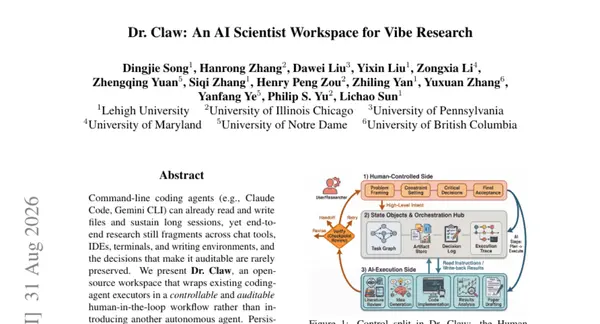
Dr. Claw: An AI Scientist Workspace for Vibe Research

124 upvotes3 comments

13 authorsno limits stated

What we saw

“Command-line coding agents (e.g., Claude Code, Gemini CLI) can already read and write files and sustain long sessions, yet end-…”

Published 2026-08-30

Fetched 2026-09-07 23:01 UTC · 17101143ec4ae6bc

Torn from — the abstract

Thread ↗
FlowBalanceon-policy self-improvementSource HF Daily Papers
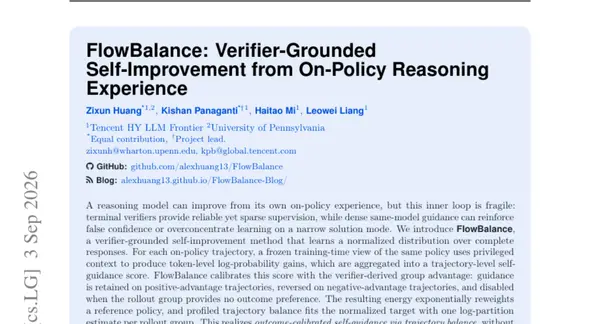
FlowBalance: Verifier-Grounded Self-Improvement from On-Policy Reasoning Experience

73 upvotes1 comments

FlowBalance4 authorsno limits stated

What we saw

“FlowBalance improves reasoning models via verifier-calibrated self-guidance using trajectory-level score reweighting and profil…”

They claim — On mathematical reasoning, FlowBalance improves average performance over FlowRL on both Qwen3-4B and Qwen3-8B, while also improving training speed and stability, avoiding direct OPSD's re…

Published 2026-09-02

Fetched 2026-09-08 16:21 UTC · 437efcb18b365a17

Torn from — the abstract

Thread ↗
cs.AISource arXiv
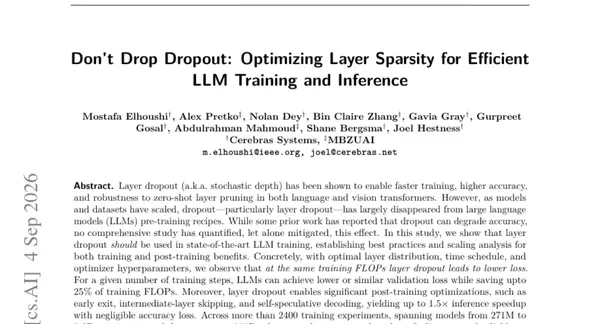
Don't Drop Dropout: Optimizing Layer Sparsity for Efficient LLM Training and Inference

17 upvotes2 comments

cs.AI9 authorsno limits stated

What we saw

“Layer dropout (a.k.a. stochastic depth) has been shown to enable faster training, higher accuracy, and robustness to zero-shot …”

They claim — For a given number of training steps, LLMs can achieve lower or similar validation loss while saving upto 25% of training FLOPs.

Published 2026-09-04

Fetched 2026-09-07 01:32 UTC · 60c554528e9aa388

Torn from — the abstract

Thread ↗
text-promptable segmentationSAMSource HF Daily Papers
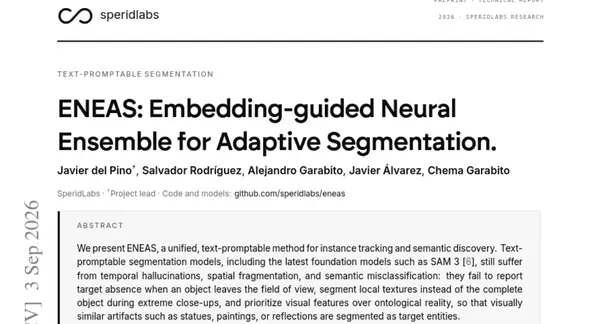
ENEAS: Embedding-guided Neural Ensemble for Adaptive Segmentation

33 upvotes2 comments

text-promptable segmentation5 authorsstates limits

What we saw

“ENEAS unifies text-prompted instance tracking and open-concept semantic discovery via temporal memory extension and a verificat…”

Published 2026-09-02

Fetched 2026-09-08 16:21 UTC · a5384a599ed5599b

Torn from — the abstract

Thread ↗
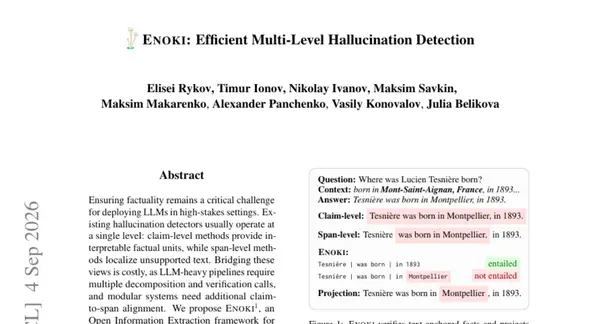
Open Information Extractionmulti-level hallucination detectionSource HF Daily Papers
Enoki: Efficient Multi-Level Hallucination Detection

21 upvotes2 comments

Open Information Extraction8 authorsno limits stated

What we saw

“Enoki is an open information extraction framework that unifies claim-level verification and span-level hallucination localizati…”

Published 2026-08-31

Fetched 2026-09-07 23:01 UTC · ab91839c3bae8764

Torn from — the abstract

Thread ↗
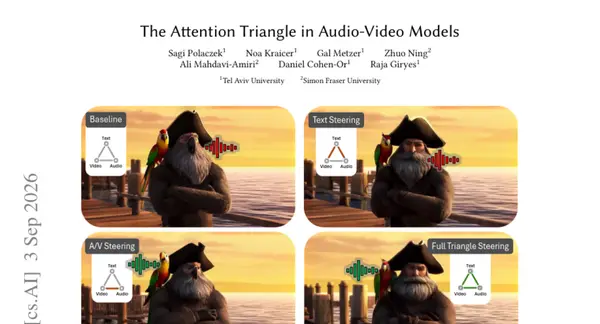
audio-video diffusion modelscross-modal attentionSource HF Daily Papers
The Attention Triangle in Audio-Video Models

29 upvotes3 comments

audio-video diffusion models7 authorsno limits stated

What we saw

“Audio-video diffusion models exhibit bidirectional semantic leakage through cross-modal attention pathways, which can be diagno…”

Published 2026-09-02

Fetched 2026-09-07 23:01 UTC · 496e910644d364a4

Torn from — the abstract

Thread ↗
search agentsmulti-hop chainsSource HF Daily Papers
Iris: Climbing to the Search Frontier

53 upvotes4 comments

search agents9 authorsno limits stated

What we saw

“Two large-scale search agents are trained via a multi-stage pipeline combining supervised fine-tuning and reinforcement learnin…”

Published 2026-09-02

Fetched 2026-09-07 23:01 UTC · bf933da181c11d7a

Torn from — the abstract

Thread ↗
spoken dialogue modelco-speech motionSource HF Daily Papers
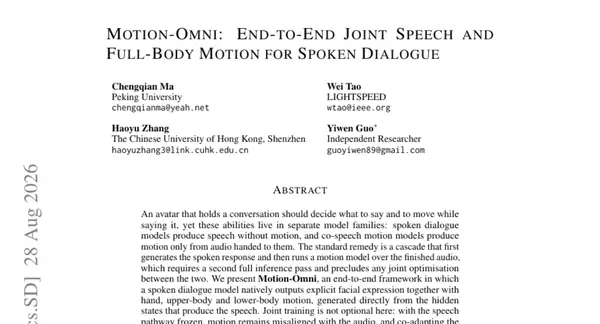
Motion-Omni: End-to-End Joint Speech and Full-Body Motion for Spoken Dialogue

38 upvotes2 comments

spoken dialogue model4 authorsno limits stated

What we saw

“Motion-Omni is an end-to-end framework that jointly generates spoken dialogue and full-body co-speech motion from shared hidden…”

They claim — We further release SwDA-500 and, to our knowledge, the first public evaluation protocol for stochastic open-ended full-body spoken dialogue, matching audio across motion systems while uni…

Published 2026-08-27

Fetched 2026-09-07 23:01 UTC · 1ae2e3cb2c0f6040

Torn from — the abstract

Thread ↗
topology-aware diffusion transformergraph-aware attention biasSource HF Daily Papers
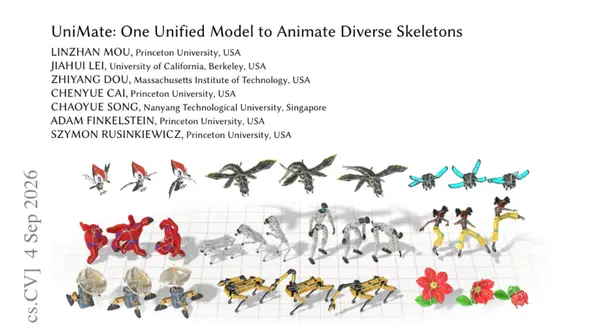
UniMate: One Unified Model to Animate Diverse Skeletons

13 upvotes2 comments

topology-aware diffusion transformer7 authorsno limits stated

What we saw

“UniMate is a unified diffusion transformer that generates articulated motion for arbitrary skeletons from text and rigged 3D as…”

They claim — UniMate introduces a topology-aware diffusion transformer, which integrates skeletal topology into attention via three mechanisms: (1) a graph-aware attention bias from pairwise joint rel…

Published 2026-09-03

Fetched 2026-09-07 23:01 UTC · f7aead1ac8cf4d5a

Torn from — the abstract

Thread ↗
compositional 3D representationobject meshesSource HF Daily Papers
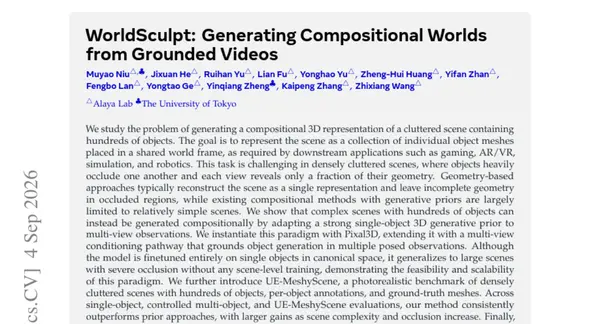
WorldSculpt: Generating Compositional Worlds from Grounded Videos

21 upvotes1 comments

compositional 3D representation12 authorsno limits stated

What we saw

“Adapting a single-object 3D generative prior to multi-view observations enables scalable compositional mesh reconstruction of d…”

Published 2026-09-03

Fetched 2026-09-07 23:01 UTC · acfc206edb29736d

Torn from — the abstract

Thread ↗

Papers, repos, models, blogs, Reddit and podcasts — once a day, by machine. Everything collected gets taken apart once — the README, the abstract, the model card — and what that turns up is kept for good, whether or not it becomes a card. Titles and links go to the original; nothing is reproduced here.

The grey line on each card is what the teardown found, not what the source advertises: the licence, the last commit, the model it was built on, whether the paper states its own limits. Open “What we saw” to check what was read to get it. Where it says listing only, the original could not be read — some sites refuse us, and we do not pretend otherwise.

A line in quotation marks is a sentence lifted from the source itself — their number, not a measurement of ours. We copy it and leave it unchecked; that is the point of quoting it.

Topics are assigned by matching words in the original title, quote and tags against a fixed list — no model reads the card. Some cards match nothing and carry no topic at all; pick a topic and those drop out. Source and topic narrow together.

Each card keeps the sentence we actually read at the moment we read it, plus a fingerprint of the response we received. That sentence — not the whole page — is what we can still stand behind if the original later changes or disappears.